NCO Professional Development Program
Presence& Bearing
A field guide to the one leader attribute your Soldiers can see at all times.
What's in here
Appearance standards changed substantially in 2025 and are still being folded into AR 670-1. Page 10 tells you how to confirm what's current. Verify before you correct.
The Leadership Requirements Model
Character
- Army Values
- Empathy
- Warrior Ethos / Service Ethos
- Discipline
- Humility
Presence
- Military & professional bearing
- Fitness
- Confidence
- Resilience
Intellect
- Mental agility
- Sound judgment
- Innovation
- Interpersonal tact
- Expertise
Leads
- Leads others
- Builds trust
- Extends influence beyond the chain of command
- Leads by example
- Communicates
Develops
- Creates a positive environment / fosters esprit de corps
- Prepares self
- Develops others
- Stewards the profession
Achieves
- Gets results
Leadership — "the activity of influencing people by providing purpose, direction, and motivation to accomplish the mission and improve the organization."
Older doctrine said process. Current doctrine says activity.
Presence, defined
The four components
| Military & professional bearing | Projecting a commanding presence, a professional image of authority. |
| Fitness | Holistic health that sustains performance and publicly signals the standard applies to you too. |
| Confidence | Projected faith in your ability, your judgment, and your team. |
| Resilience | Recovering from setback and continuing to function — visibly. |
Character is inferred over weeks. Intellect is demonstrated when a problem appears. Presence is seen in seconds, continuously, whether or not you're doing anything.
It is the interface between what you are inside and the people you're trying to influence. If the interface is broken, the rest never reaches them.
Bearing — three channels
Looks like
- Posture — spine straight, shoulders back and down, head level, hands still. Costs nothing.
- Uniform — serviceable and correct. Not new. Consistent Monday and Friday.
- Movement — deliberate. You don't scurry and you don't saunter.
- Eye contact — at the person, not past them. Phone down.
- Position — front and visible, not hidden behind the formation.
Sounds like
- Volume calibrated to the room, not to your emotion.
- Economy — fewer words, more weight on each one.
- No filler — "uh," "like," "you know," "does that make sense?"
- Pace — slower reads as certain. Nervous accelerates.
- Profanity is a volume knob you can only turn once.
Feels like (to them)
- Predictability — the same NCO on Monday and Friday.
- Contagious calm — if you spike, they spike.
- No mood-reading tax — nobody asks "what kind of mood is he in?"
- A fixed standard — doesn't move based on who's watching.
The sentence that buys the most credibility: "I don't know. I'll find out and get back to you by 1500." Then do it. The deadline is what separates it from dodging.
Bearing under stress
On a good day bearing is optional. That is not when it's graded.
Your Soldiers mirror your arousal level, close to involuntarily. The NCO who deliberately drops their voice a half-step and slows their pace in a crisis is buying cognitive room for the whole squad.
That is a tactical act, not a personality trait.
Where it gets tested
- The range that goes long and cold
- The inspection you fail in front of your Soldiers
- The call at 0300
- The order you disagree with and execute anyway
- Absorbing a correction from your own leadership, in front of them
Nobody improvises composure. You decide how you'll behave under stress before the stress arrives — or the stress decides for you.
Resilience is a lesson plan
Your Soldiers only observe resilience when something has already gone wrong. The failed inspection is the lesson. You don't choose whether you're teaching in those moments — only what.
What bearing is not
Bearing is
- Composure that holds when things go wrong
- Consistency across days and audiences
- Competence made visible
- Approachable and respected — not in tension
- Correcting without humiliating
Bearing is not
- Arrogance, or never admitting error
- Shouting, or performing anger you don't feel
- Emotional distance — "they can't know anything about me"
- Being unapproachable and calling it standards
- Smoking a Soldier to establish who's in charge
- A different face for the first sergeant than for your privates
Confidence admits the gap. Arrogance hides it.
"I don't know, I'll find out" / "I was wrong, here's the correction" / "Show me how you did that" / "My call, my fix."
How the four interlock
| Slips | They see | They conclude |
|---|---|---|
| Bearing | Inconsistent mood, sloppy uniform, avoidable lateness | "The standard is negotiable." |
| Fitness | An NCO enforcing a standard they visibly don't meet | "Rules are for us, not them." |
| Confidence | Hedging, guessing, deferring every decision upward | "We're not actually being led." |
| Resilience | Visible rattling; blame distributed downward | "Don't bring him bad news." |
Every conclusion in that last column degrades readiness — and none of them required you to be bad at your MOS.
When one of your Soldiers has a real problem at 2200 on a Saturday — do they call you?
That is the truest measure of your presence, and the only one you can't fake.
Self-assessment
Now the real step: hand this page to a peer who will tell you the truth and ask them to score you. You cannot see your own bearing. The gap between the two columns is your development plan.
Which standard is current
Read this before you correct anyone on appearance. AR 670-1 alone will give you the wrong answer right now.
| Publication | Date | Governs |
|---|---|---|
| AR 670-1 | 26 Jan 2021 | Base regulation — wear and appearance |
| AD 2022-09 | 2022 | Soldier tattoos |
| AD 2025-13 | 2025 | Facial hair / shaving profiles |
| AD 2025-18 | 2025 | Appearance, grooming, ABCP |
How this works
- AD 2025-18 is to be folded into AR 670-1 within one year, and is rescinded when the revised regulation publishes.
- Until then, the directive controls. Quoting the 2021 regulation on hair or nails means quoting a superseded standard.
- Unit and command policies may be more restrictive. Know yours.
Army Publishing Directorate — armypubs.army.mil — is the authority. Confirm the directive hasn't been incorporated or superseded before you teach or enforce from this book.
The Army's stated reason, verbatim: a well-maintained military appearance reflects "disciplined attention to detail, respect for authority, and pride in oneself and the Army that are critical to building cohesive teams and enabling an effective warfighting organization." AD 2025-18, para 4a
Male grooming
| Bulk, top | Max 2 inches from the scalp |
| Bulk, sides | Max 1 inch |
| Taper / fade | Starts at zero length (skin fade) or 1/4 inch at the sideburns and around the ears. Blends evenly around sides and back. Will not fall over the ears. |
| Collar | Only shaved or closely cut hair on the back of the neck may touch it |
| Part | One cut part if hair doesn't part naturally — max 1/8 inch wide, one straight line, or aligned with the natural hairline |
| Prohibited | Locs, braids, twists. Designs shaped or cut into hair or scalp. Asymmetrical or headgear-distorting styles. |
| Color | Natural shades only, blended and subtle, free of abrupt or extreme artificial contrasts |
| Shaved head | Authorized |
| Edged cuts | Authorized if natural to the Soldier's hairline |
Headgear rule that governs everything: no hairstyle may distort the fit of prescribed headgear, interfere with protective equipment, or create a health or safety hazard — whether or not the headgear is being worn at the time. No oversized headgear to accommodate bulk.
Male hair — measured
Female grooming
| Buns | Back of the head, max 3 inches from the scalp, no wider than the head. Centered, horizontally in line with the top of the ears. Bottom at or above the collar. |
| Ponytails | Single braided or unbraided, ACU and APFU only. Bulk not to exceed head width. Max 6 in. from the top of the collar, min 1 in. from the holder. Centered, in line with the top of the ears. |
| Braids | Up to two, down the center of the back, parallel, equal length and width. Max 2 in. wide, max 6 in. from the top of the collar. Not over the shoulder or in front of the body. |
| Locs, twists, cornrows | Uniformly styled, gathered into braids or a single ponytail for a cohesive appearance; must then meet the ponytail standard. |
| Dress uniform | No ponytails or braided ponytails in any dress variation. Above the collar or in a bun above the collar for service/dress. |
| Bangs | Above the eyebrows; no shorter than mid-forehead |
| Tapered styles | Shorter sides/back with longer top authorized; top max 2 in. from the scalp. May not be combined with other authorized styles. |
| Devices | Closely match hair color, discreet, max 1/2 inch thick |
| Length | No minimum. Shaved or trimmed head authorized. |
Female hair — measured
Cosmetics & fingernails
Cosmetics
- Male: prohibited absent medical exemption.
- All Soldiers: clear lip moisturizer permitted.
- Female: for an even, uniform skin tone matching natural complexion, applied conservatively. Not to enhance or alter features with non-matching color.
- Lipstick not authorized. Clear or skin-tone tinted lip gloss is. Lip liner not authorized absent medical exemption.
- Eyelash extensions of any kind not authorized. False eyelashes only by medical profile for loss of natural lashes; must match natural color, max 9 mm.
- Semipermanent makeup authorized if conforming. Tattooed (permanent) makeup is not.
- Makeup to cover tattoos is prohibited.
Fingernails
- Male: no nail polish of any kind — including clear — absent medical exemption. Trimmed, not past the fingertip.
- Female: clear polish only. Max 1/4 inch past the fingertip.
- All Soldiers: square or rounded shapes only.
The directive ties nail length to function — snagging on tools and safety equipment, and the fit of gloves. That's your answer when a Soldier asks why it matters.
Earrings & piercings
- Male: not authorized in any military uniform or on duty in civilian attire.
- Female: authorized in ACU, dress, and service uniforms.
- Matched pair, one per standard earlobe.
- Not authorized in the cartilage, industrial, transverse lobe, tragus, or conch.
- Screw-on, clip-on, or post. Gold, silver, clear diamond, or white/ivory pearl.
- Max 6 mm / 1/4 inch diameter. Unadorned, spherical or square.
- Fit snugly. No hoop, two-sided, or drop earrings.
No other facial or visible piercings in any uniform. Clear nose ring gauges and retainers are specifically not authorized — this is the most common misconception in the formation.
No earrings during physical fitness activities, in tactical or field environments, during combat or operational deployments, or where regular hygiene isn't available. None in the APFU.
Tattoos & facial hair
Tattoos — AR 670-1 para 3-3, expanded by AD 2022-09
- Prohibited: head, face, inside eyelids, mouth, ears.
- Authorized by exception: one per hand, max 1 in.; one ring tattoo per hand below the bottom finger joint; between the fingers if not visible when closed; one on the back of the neck, max 2 in.; one behind each ear, max 1 in., not forward of the earlobe.
- Content prohibited anywhere on the body: extremist, indecent, sexist, racist.
- Who decides: company-level commander for serving Soldiers. Appeals to the first O-6 in the chain.
Facial hair — AD 2025-13
All male Soldiers clean-shaven unless granted a medical exception to policy or approved religious accommodation.
- Permanent shaving profiles are prohibited.
- Medical exceptions (e.g. pseudofolliculitis barbae) follow a phased treatment plan — Phase I up to 30 days, Phase II up to 60, Phase III up to 90, optional Phase IV laser treatment.
- Religious accommodation is a separate process and remains available.
NCO action: if you have Soldiers who held long-standing shaving profiles, they are affected and may not know it. Getting them in front of a provider before it becomes a counseling is the job. Verify current phase requirements with your provider and S-1 — implementation guidance is still developing.
Tattoos — where
AGSU — where it goes
The official plates
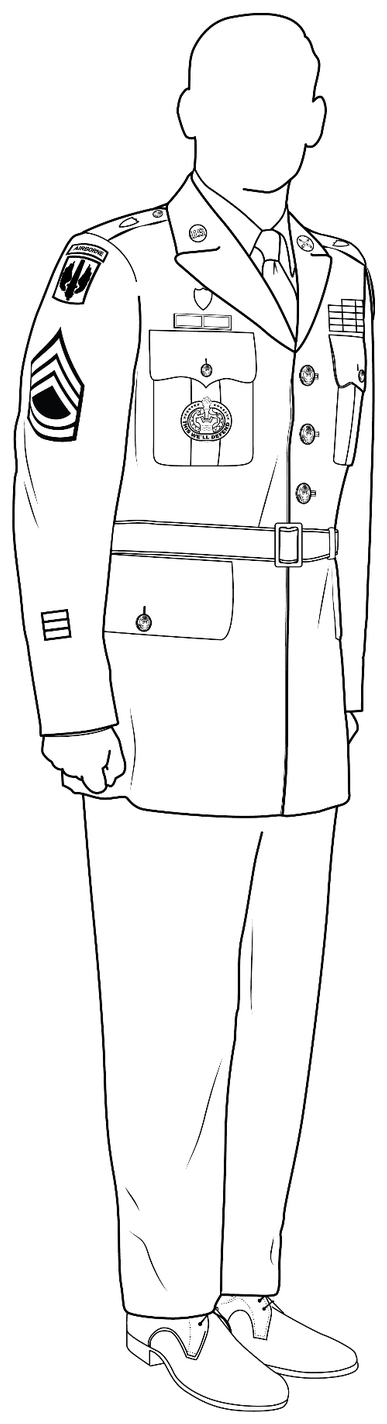
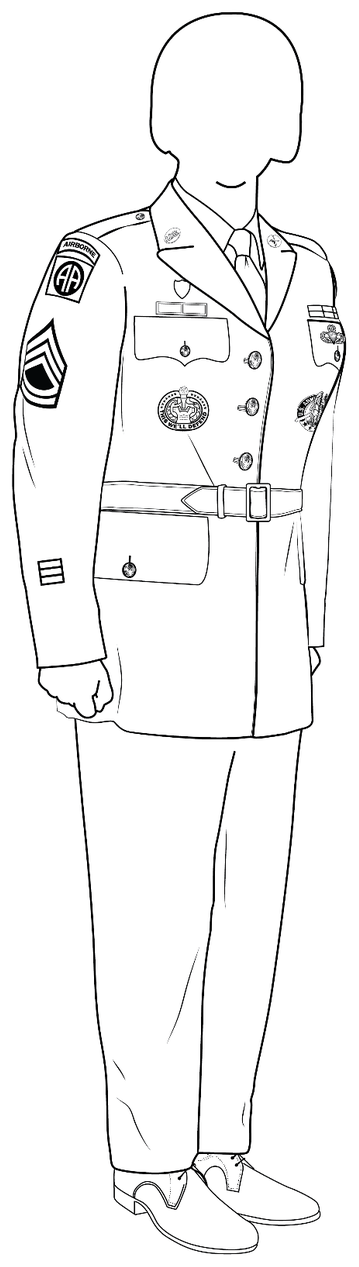
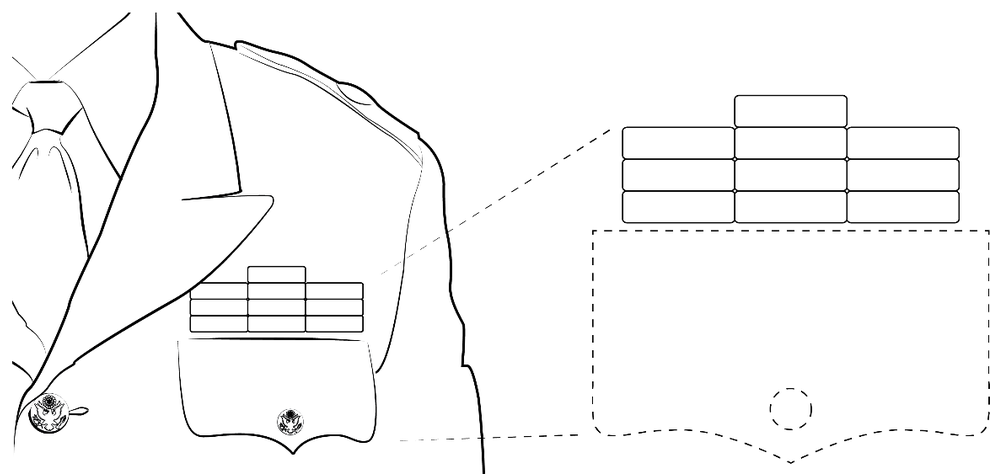
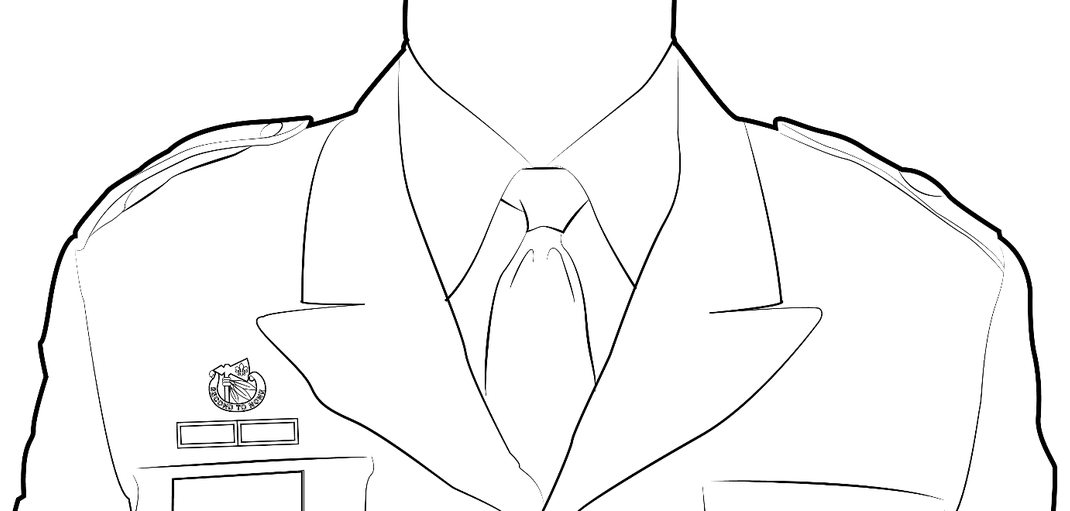
These plates are dated 26 January 2021. Use them for insignia placement. For hair, nails, cosmetics and earrings, AD 2025-18 controls — see pages 11 to 16.
AGSU rules people miss
| Black beret | Not worn with any variation of the AGSU. |
| Nameplate | Required on the coat, both shirts, the Ike jacket and the heritage 564 pullover. Not on the leather jacket or windbreaker. Last names only. 1 × 3 in, dark brown with taupe lettering, 3/8 in block letters. |
| Neck tab | Required with the long-sleeved shirt worn without the coat, and with either shirt worn with the Class A coat. Optional with the short-sleeved Class B. |
| Windbreaker | Zipped to at least the second button down. Officers: pin-on grade on shoulder loops. NCOs: shoulder marks. Other enlisted: grade on the collars. Not in formation unless the commander authorizes. |
| Badges | One combat or special skill badge or metal tab replica. Driver and mechanic badges not above the ribbons. Only Groups 3 and 4 below the ribbons. |
| ID badges | Not authorized on the AGSU tropical dress variation or Class B. |
| Rank embroidery | Soldiers are authorized to embroider current rank on the AGSU coat and Ike jacket. |
| Oxfords | Polished regularly. |
Heritage colors by name: heritage green, taupe 565, tan 566, walnut 567.
OCP, PT, and the ABCP
ACU / IHWU
- Full-color SSI and SSI-MOHC only when authorized by the commander.
- Worn centered on the hook-and-loop pad, centered both horizontally and vertically on the sleeve pocket.
- Full-sized full-color special skill tabs may be worn with the full-color SSI.
APFU — runner’s belt
- Black only, no wider than 4 inches.
- Commanders may authorize leaders to wear one — APFU only, never with OCP or service uniforms.
- A cellphone may be placed in the belt, not visible.
- No headphones or earpieces — wireless or wired — during outdoor PT.
ABCP — the Guard rule
Commanders will direct a body fat assessment on any Soldier who “does not present a Soldierly appearance.”
- ARNG / USAR: exceeding standards after 6 months in the ABCP → involuntary transfer to the IRR.
- RA / AGR: same clock → commander initiates separation absent a diagnosed medical condition.
- Flag Code K is no longer transferable.
Head-to-toe sweep
The on-the-spot correction
- Private when you can. Public when you must.Safety and standards affecting the formation get corrected now.
- Name the standard, not the person."The reg says 1/4 inch" — not "you look like a mess." Makes it about a fixable behavior, and protects you.
- State the correction and the timeline."Fixed before first formation Sunday."
- Check back.An uncorrected correction teaches that standards are optional.
- One at a time.Stacking five corrections is a counseling, not a correction.
Sounds like
- "Hey Sergeant — sidewalls. Before formation." Four seconds. No audience.
Doesn't sound like
- Sarcasm, or a lesson staged for onlookers
- "I shouldn't have to tell you this"
- Correcting a Soldier in front of their own subordinates — you just spent their authority to do it
Your authority, in writing: "any Soldier can address a situation that warrants an on-the-spot-correction." AD 2025-18, para 4a
Counterproductive leadership
What it looks like
- Public humiliation used as a correction tool
- Taking credit; distributing blame downward
- Different standards for favorites
- Withholding information to stay necessary
- Performing for seniors, dismissive with subordinates
What it costs
- Soldiers stop reporting problems early
- Initiative disappears — nobody risks being wrong
- Your best people transfer or don't reenlist
- Climate degrades faster than it recovers
The definition ends on climate. This isn't about being unpleasant — it's about producing an environment in which the mission can't be accomplished.
Doctrine naming these behaviors is what lets you raise a concern about a peer or a senior as a professional observation rather than a personal complaint. Use the language.
Developing presence
FM 6-22 covers the methods that span leader development: assessing, counseling, coaching, mentoring, broadening, and team building.
Assess → Feedback → Practice → Reassess.
Presence is trainable. It is not a personality you were issued. But it will not improve without an outside observer — you cannot see your own bearing.
Three things you can do this drill
- Ask for it. "What do I look like when I'm stressed?" Ask a peer who'll tell you the truth.
- Counsel on it. Presence is a legitimate developmental counseling topic — DA Form 4856. Almost nobody uses it this way.
- Name it when you see it. "The way you handled that formation — that's what bearing looks like." Positive correction is still correction.
Off duty and online
The Creed says "at all times… regardless of the situation." In the Guard your Soldiers live in your town, shop where you shop, and follow you online.
The test: would this post, this conversation, or this Saturday night make it harder for one of my Soldiers to take an order from me on Sunday morning?
Self-check
- Name the three attributes in the LRM.
- Name the three competencies.
- Name the four components of Presence.
- Define military and professional bearing.
- Which TC is the NCO Guide? Current edition?
- Max bulk of male hair — top? sides?
- Which uniforms allow a female ponytail?
- Which AR 670-1 paragraph governs tattoos?
- Define counterproductive leadership.
- Which form is developmental counseling?
References
| ADP 6-22 | Army Leadership and the Profession (2019) |
| FM 6-22 | Developing Leaders (Nov 2022) |
| AR 670-1 | Wear and Appearance of Army Uniforms and Insignia (26 Jan 2021), as amended |
| AD 2025-18 | Appearance, Grooming, and ABCP Standards |
| AD 2025-13 | Facial Hair Grooming Standards |
| AD 2022-09 | Soldier Tattoos |
| TC 7-22.7 | The Noncommissioned Officer Guide (Aug 2025) |
| DA 4856 | Developmental Counseling Form |
Quotations are reproduced from the publications above. Paragraph-level citations are given only where verified against the source document. Confirm at armypubs.army.mil before enforcing or teaching from this book.
My commitments
The third is the hardest. Every NCO has a standard they've quietly decided isn't worth the friction — and their Soldiers know exactly which one it is, because they learned it by watching you walk past it.
No one is more professional than I.