NCODP Leader Presence & Military Bearing

NCO Professional Development Program

Leader Presence& Military Bearing

They read you before they hear you. This block is about what they read — and how to control it.

ADP 6-22 FM 6-22 AR 670-1 TC 7-22.7
Instructor: ______________________
Administrative0:01

Before we start

Housekeeping, safety, and how this block ends
  • Sign the roster — it's circulating now. Rank, full name, last four, signature.
  • Exits are here and here. Latrines: ____. AED: ____.
  • Risk assessment briefed and on file — residual risk LOW.
  • Phones on silent. You'll use one for the knowledge check if you want to.
  • AAR at the end. It's not a formality — it builds the next NCODP.
Ground rule

Nothing said in this room gets attributed outside this room. We're going to talk about leaders we've worked for. Describe behavior, never name people.

NCODP · Leader Presence & Military Bearing
Administrative0:03

What you'll walk out with

Terminal and enabling learning objectives
Terminal learning objective

Given the leadership requirements of ADP 6-22 and the appearance standards of AR 670-1 as amended, apply the leader attribute of Presence to daily NCO duties, and build one personal development action using a method from FM 6-22.

  1. Locate Presence within the Army Leadership Requirements Model.
  2. Define the four components of Presence.
  3. Describe how military and professional bearing is projected — and how it is read.
  1. Apply current Army appearance standards as a leadership tool, not a gotcha.
  2. Identify counterproductive behaviors that erode presence.
  3. Commit to three actions before next drill.
NCODP · Leader Presence & Military Bearing
Opening0:04

The seven-second read

What happens before you open your mouth

A Soldier who has never met you forms a working judgment of you almost immediately. They are reading:

  • How you're standing
  • Whether your uniform says you care
  • Whether you look like you slept
  • Whether you're looking at them or past them
  • Whether you seem certain
The point

None of that is vanity. All of it is bandwidth — how much credibility you have available before you've spent a single word earning it.

You can start every interaction in credit or in debt. Presence decides which.

NCODP · Leader Presence & Military Bearing
OpeningADP 6-22

Why this is a readiness issue

Not a customs-and-courtesies issue
Trust is the binding agent that enables coordinated action across a group in order to reach common goals. Center for Army Leadership · foundations of Army leadership, ADP 6-22

Hesitation costs time

A Soldier who doubts you pauses to evaluate the order before executing it. In garrison that's friction. In contact it's casualties.

Presence is a control measure

Your calm sets the arousal level of everyone who can see you. That is a safety control you carry at all times.

It compounds

Every interaction either adds to or withdraws from the account. Nobody gets to reset it on the morning it matters.

NCODP · Leader Presence & Military Bearing
Opening0:06

Where we're going

50-minute block · flexes down to 30
0:00–0:05Admin, hook, why it matters01–06
0:05–0:12Where Presence lives in doctrine07–13
0:12–0:20Military bearing, decoded14–20
0:20–0:24Fitness, confidence, resilience21–24
0:24–0:31Grooming — the standard in writing25–32
0:31–0:39Wearing it right — the uniform33–39
0:39–0:43The on-the-spot correction40–41
0:43–0:47The NCO as standard-bearer42–46
0:47–0:50Knowledge check, commitments, AAR47–49
NCODP · Leader Presence & Military Bearing
Block 1 — Where Presence LivesADP 6-22, Ch. 1

Start with the definition

Because the wording changed, and the change matters
Leadership is the activity of influencing people by providing purpose, direction, and motivation to accomplish the mission and improve the organization. ADP 6-22, Army Leadership and the Profession (2019)
What changed in 2019

Doctrine used to call leadership a process. The current publication calls it an activity.

A process is something you're inside of. An activity is something you do, on purpose, repeatedly. Influence isn't a status your rank confers on you — it's work you perform or fail to perform every day.

NCODP · Leader Presence & Military Bearing
Block 1 — Where Presence LivesADP 6-22, Ch. 1

Who counts as a leader

…anyone who by virtue of assumed role or assigned responsibility inspires and influences people to accomplish organizational goals. ADP 6-22 — definition of an Army leader
Assigned responsibility

The obvious half. You're the squad leader, so you lead the squad. Rank and position put you there.

Assumed role

The half people skip. You don't need the position to be the leader in the moment. The SPC who steps up when the convoy stops is exercising leadership under this definition — and so is the SSG who doesn't.

NCODP · Leader Presence & Military Bearing
Block 1 — Where Presence LivesADP 6-22

The Leadership Requirements Model

The whole framework on one page — Presence is one third of the top band
Attributes
what a leader IS
Character
  • Army Values
  • Empathy
  • Warrior Ethos / Service Ethos
  • Discipline
  • Humility
Presence
  • Military & professional bearing
  • Fitness
  • Confidence
  • Resilience
Intellect
  • Mental agility
  • Sound judgment
  • Innovation
  • Interpersonal tact
  • Expertise
Competencies
what a leader DOES
Leads
  • Leads others
  • Builds trust
  • Extends influence beyond the chain of command
  • Leads by example
  • Communicates
Develops
  • Creates a positive environment / fosters esprit de corps
  • Prepares self
  • Develops others
  • Stewards the profession
Achieves
  • Gets results
NCODP · Leader Presence & Military Bearing
Block 1 — Where Presence LivesADP 6-22

Why Presence is the odd one out

Of the three attributes, only one is visible at all times
AttributeHow your Soldiers actually access itTime to read
CharacterInferred, slowly, from a pattern of decisions — especially the ones that cost you something.Weeks to years
IntellectDemonstrated when a problem shows up and they watch how you solve it.Days to months
PresenceSeen. Immediately. Continuously. Whether or not you're doing anything.Seconds

Presence is the interface between the character and intellect you have on the inside and the people you're trying to influence on the outside. If the interface is broken, the rest of it never reaches them.

NCODP · Leader Presence & Military Bearing
Block 1 — Where Presence LivesADP 6-22, Ch. 3

Presence, defined

Presence is the sum of a leader's outward appearance, demeanor, actions and words, and the inward character and intellect of the leader. ADP 6-22, Chapter 3 — Presence

Read the back half of that sentence again. Doctrine explicitly refuses to define presence as appearance alone.

Presence includes

  • Outward appearance
  • Demeanor
  • Actions
  • Words
  • The character underneath
  • The intellect underneath

So "squared away" is necessary but not sufficient

  • A perfect uniform on an NCO who lies is not presence.
  • A commanding voice with nothing behind it is not presence.
  • The outward half without the inward half is a costume.
NCODP · Leader Presence & Military Bearing
Block 1 — Where Presence LivesADP 6-22, Ch. 3

The four components

Memorize these four — they are board material and they are the rest of this class

Military & professional bearing

Projecting a commanding presence and a professional image of authority.

Fitness

Holistic health that sustains performance — and publicly signals that the standard applies to you.

Confidence

Projected faith in your own ability, your judgment, and your team.

Resilience

Recovering from setback and continuing to function — visibly.

Block 2 takes the first one apart in detail. Block 3 covers the other three. All four are in your pocket book with a self-assessment.

NCODP · Leader Presence & Military Bearing
Block 1 — Where Presence Lives0:12

Talk to me

Discussion 1 · 3 minutes

Think of an NCO whose presence you'd want to copy. Don't name them.

  • What is the one specific thing they did that you still remember?
  • Was it something they said, something they did, or just how they were?
Listen for this

Almost nobody answers with "their uniform was perfect." People remember how a leader behaved on a bad day. Capture two or three answers on the board — you'll call back to them in Block 2.

NCODP · Leader Presence & Military Bearing
Block 2 — Military Bearing, DecodedADP 6-22, Ch. 3

Military and professional bearing

Projecting a commanding presence, a professional image of authority. ADP 6-22 — military and professional bearing
"Commanding"

Does not mean loud. A commanding presence is one that draws attention and holds it — not one that demands it. The loudest person in the motor pool is usually the least commanding.

"Authority"

Here this means credibility, not power. You already have positional power. Bearing is how you earn the kind of authority that works when you're not in the room.

Bearing has three channels. Your Soldiers are monitoring all three, all the time.

NCODP · Leader Presence & Military Bearing
Block 2 — Military Bearing, DecodedChannel 1 of 3

What bearing looks like

The visual channel — free, and always transmitting
SignalWhat good looks likeWhat it costs you
PostureSpine straight, shoulders back and down, head level, hands still.Nothing. It is the highest-return fix available to you.
UniformServiceable and correct. Not new — correct. Consistent Monday and Friday.Ten minutes the night before.
MovementDeliberate. You don't scurry and you don't saunter. You arrive where you intended to be.Leaving five minutes earlier.
Eye contactYou look at the person you're speaking to and at the Soldier speaking to you.Putting the phone down.
PositionWhere you physically stand. Front and visible, or behind the formation where nobody can see you?Willingness to be watched.
NCODP · Leader Presence & Military Bearing
Block 2 — Military Bearing, DecodedChannel 2 of 3

What bearing sounds like

The vocal channel — where most NCOs leak credibility
  • Volume calibrated to the space, not to your emotion. A room this size never needs a raised voice.
  • Economy of words. The fewer you use, the more each one weighs. Leaders who over-explain sound like they're negotiating.
  • Filler discipline. "Uh," "like," "you know," "I mean," "does that make sense?" Every one is a small withdrawal.
  • Pace. Slower reads as more certain. Nervous people accelerate.
The profanity problem

Profanity is a volume knob you can only turn once. If it's in every sentence, you have nothing left for the sentence that actually matters.

The most powerful sentence you own

"I don't know. I'll find out and get back to you by 1500."

Then do it. Guessing in front of Soldiers is a one-time credibility expense with a long repayment schedule.

NCODP · Leader Presence & Military Bearing
Block 2 — Military Bearing, DecodedChannel 3 of 3

What bearing feels like to them

The channel you can't see — and the one that decides whether they bring you problems

Predictability

The same NCO on Monday and on Friday. Soldiers can plan around a predictable leader. They can only survive an unpredictable one.

Contagious calm

Arousal is transmissible. If you spike, the section spikes. If you slow down, they slow down.

No mood-reading tax

Nobody should have to ask a battle buddy "what kind of mood is he in?" before approaching you. That question is a symptom.

A fixed standard

The standard doesn't move based on who's watching, who's friends with who, or how tired you are.

The diagnostic

When one of your Soldiers has a real problem at 2200 on a Saturday — do they call you? That answer is the truest measure of your presence, and it is the only one on this slide you can't fake.

NCODP · Leader Presence & Military Bearing
Block 2 — Military Bearing, DecodedADP 6-22

Bearing under stress

On a good day it's optional. That's not when it's graded.

Anyone can hold bearing in a classroom. The requirement exists because of the other days:

  • The range that goes long and cold
  • The inspection you fail in front of your Soldiers
  • The call at 0300
  • The order you disagree with and have to execute anyway
The mechanism

Your Soldiers mirror your arousal level. It is close to involuntary.

The NCO who deliberately drops their voice a half-step and slows their pace in a crisis is buying cognitive room for the entire squad. That is a tactical act, not a personality trait.

The hard part: you have to decide how you'll behave under stress before the stress arrives. Nobody improvises composure.

NCODP · Leader Presence & Military Bearing
Block 2 — Military Bearing, Decoded0:21

What bearing is not

Clearing out what a lot of us were taught by example

Bearing is

  • Composure that holds when things go wrong
  • Consistency across days and audiences
  • Competence made visible
  • Approachable and respected — these are not in tension
  • Correcting a Soldier without humiliating them

Bearing is not

  • Arrogance, or never admitting error
  • Shouting, or performing anger you don't feel
  • Emotional distance — "they can't know anything about me"
  • Being unapproachable and calling it standards
  • Smoking a Soldier to establish who's in charge
  • A different face for the first sergeant than for your privates
NCODP · Leader Presence & Military Bearing
Block 2 — Military Bearing, Decoded0:22

Where does yours break?

Discussion 2 · 3 minutes

Everyone's bearing fails somewhere. Where does yours go first?

  • When you're tired?
  • When you're angry?
  • When you're not confident you know the task?
  • When you're embarrassed in front of your own leadership?

Nobody's answer is "it doesn't." If you think yours doesn't break, ask your Soldiers — they've already catalogued it.

NCODP · Leader Presence & Military Bearing
Block 3 — The Other ThreeADP 6-22, Ch. 3

Fitness

Component 2 of 4 — and it is not just your ACFT score
Physically fit people feel more competent and confident, handle stress better, work longer and harder, and recover faster. ADP 6-22, Chapter 3 — on fitness

Doctrine treats fitness as holistic — it is not one number. Holistic Health and Fitness covers:

  • Physical — strength, endurance, mobility
  • Nutritional — what fuels the performance
  • Mental — cognitive and emotional readiness
  • Spiritual — the thing that gets you through
  • Sleep — the one NCOs brag about skipping
Why it belongs under Presence

Fitness is in the Presence attribute — not somewhere else — because it is publicly legible.

Your fitness is a continuous public statement about whether you believe the standard you enforce also applies to you. Soldiers do that math immediately and they are never wrong about it.

NCODP · Leader Presence & Military Bearing
Block 3 — The Other ThreeADP 6-22, Ch. 3

Confidence

Component 3 of 4 — faith in your ability, your judgment, and your team, projected outward
SituationConfidence sounds likeArrogance sounds like
You don't know something"I don't know — I'll find out."A confident-sounding guess.
You were wrong"I was wrong. Here's the correction.""Well, what I meant was…"
A Soldier outperforms you"Show me how you did that."Finding a reason it doesn't count.
Your plan fails"My call, my fix."A list of what everyone else did wrong.

Confidence admits the gap. Arrogance hides it. The most confident thing an NCO can say in front of their Soldiers is "I was wrong" — because only someone secure in their standing can afford it.

NCODP · Leader Presence & Military Bearing
Block 3 — The Other ThreeADP 6-22, Ch. 3

Resilience

Component 4 of 4 — the capacity to recover and keep functioning

Resilience is the one component your Soldiers only get to observe when something has already gone wrong. Which means:

  • The failed inspection is the lesson plan
  • The bad AAR is the lesson plan
  • How you absorb a correction from your own leadership, in front of them, is the lesson plan

You don't get to choose whether you're teaching in those moments. Only what.

The NCO's second job

Resilience under Presence isn't only about surviving your own setbacks. It's about being the stable thing your Soldiers orient on during theirs.

A squad can absorb a great deal of chaos if one person in it is visibly unshaken.

NCODP · Leader Presence & Military Bearing
Block 3 — The Other Three0:29

How the four interlock

Failure in one component shows up as damage in the others
When this slips……your Soldiers see this…and they conclude
BearingInconsistent mood, sloppy uniform, avoidable lateness"The standard is negotiable."
FitnessAn NCO who enforces a standard they visibly don't meet"Rules are for us, not them."
ConfidenceHedging, guessing, deferring every decision upward"We're not actually being led."
ResilienceVisible rattling after a setback; blame distributed downward"Don't bring him bad news."

Read the right-hand column again. Every one of those conclusions degrades readiness — and none of them required you to be bad at your MOS.

NCODP · Leader Presence & Military Bearing
Block 4 — The Standard in WritingAR 670-1

Know which standard is current

The regulation alone will get you the wrong answer right now
PublicationDateWhat it governs
AR 670-126 Jan 2021Base regulation — wear and appearance of Army uniforms and insignia.
AD 2022-092022Soldier tattoos — expanded authorized placements.
AD 2025-132025Facial hair grooming standards and shaving-profile policy.
AD 2025-182025Appearance, grooming, and Army Body Composition Program standards.
Why this slide exists

AD 2025-18 directs that its provisions be folded into AR 670-1 within one year, and that it is rescinded when the revised regulation publishes. Until then the directive controls — and an NCO quoting the 2021 regulation on hair or nails will be quoting a superseded standard.

And note: unit and command policies may be more restrictive than AR 670-1. Check yours.

NCODP · Leader Presence & Military Bearing
Block 4 — The Standard in WritingAD 2025-18

The Army's own stated reason

Read this before you correct anybody
A well-maintained military appearance reflects disciplined attention to detail, respect for authority, and pride in oneself and the Army that are critical to building cohesive teams and enabling an effective warfighting organization. Army Directive 2025-18, para 4a
Note what it does not say

It doesn't say "because it looks nice" or "because I said so." It draws a straight line from appearance to cohesion to warfighting capability.

That line is your entire justification when a Soldier asks why it matters. Use it.

And on who enforces

"Commanders, supported by the noncommissioned officer support chain, will enforce the standards…"

"…any Soldier can address a situation that warrants an on-the-spot correction."

Enforcement is named as an NCO function in the directive itself — and it is not reserved to NCOs.

NCODP · Leader Presence & Military Bearing
Block 4 — The Standard in WritingAD 2025-18, encl 1

Male grooming — current standard

MALE AD 2025-18, Encl 1 2 in 1 in sides taper / fade part, max 1/8 in not over the ears collar
Dashed line is the maximum bulk envelope. Bulk may not exceed 2 inches at the top of the scalp or 1 inch at the sides. The taper or fade begins at zero length — a skin fade — or at 1/4 inch at the sideburns and around the ears, and blends evenly around the sides and back. Hair will not fall over the ears, and only shaved or closely cut hair on the back of the neck may touch the collar. A cut part is permitted where the hair does not part naturally, no wider than 1/8 inch. Not authorized: locs, braids, twists, and designs shaped or cut into the hair or scalp.
ItemStandard
Bulk — topWill not exceed 2 inches from the scalp.
Bulk — sidesWill not exceed 1 inch.
Taper / fadeMust be tapered or faded starting at zero length (skin fade) or 1/4 inch at the sideburns and around the ears. Must blend evenly around sides and back; will not fall over the ears.
At the collarOnly shaved or closely cut hair on the back of the neck may touch the collar.
PartsIf hair doesn't part naturally, one cut part is authorized — no wider than 1/8 inch, one straight line, or aligned with the natural hairline if slanted/curved.
ProhibitedLocs, braids, and twists are not authorized for male Soldiers. No designs shaped or cut into hair or scalp. No asymmetrical or distorting styles.
ColorNatural shades only, blended and subtle, free of abrupt or extreme artificial contrasts.
Shaved headAuthorized.
NCODP · Leader Presence & Military Bearing
Block 4 — The Standard in WritingAD 2025-18, encl 1

Female grooming — current standard

BUN service, dress and utility ear line collar 3 in max PONYTAIL ACU and APFU only collar 6 in max from collar bulk ≤ width of head
Bun — worn at the back of the head, maximum 3 inches from the scalp and no wider than the head, centered and horizontally in line with the top of the ears; the bottom may fall at or above the collar. Ponytail — a single braided or unbraided ponytail, in the ACU and APFU only: maximum 6 inches measured from the top of the collar, minimum 1 inch from the base of the holder, centered and in line with the top of the ears. Braids — up to two, parallel down the center of the back, equal in length and width, each no more than 2 inches wide and 6 inches from the top of the collar, never worn over the shoulder or pulled in front of the body. No ponytails or braided ponytails in any dress uniform variation.
ItemStandard
BunsWorn at the back of the head; may extend a maximum of 3 inches from the scalp, no wider than the head. Centered, horizontally in line with the top of the ears. Bottom may fall at or above the collar.
PonytailsSingle braided or unbraided, ACU and APFU only. Bulk not to exceed the width of the head. Max 6 inches from the top of the collar; min 1 inch from the base of the holder. Centered, in line with the top of the ears.
BraidsUp to two braids, down the center of the back, parallel, equal length and width. No braid over 2 inches wide or longer than 6 inches from the top of the collar. Not over the shoulder or pulled in front of the body.
Locs / twists / cornrowsMay be uniformly styled and gathered into braids or a single ponytail for a cohesive appearance; the ponytail must then meet the ponytail standard.
Dress uniformNo ponytails or braided ponytails in any dress uniform variation. Hair styled above the collar or in a bun above the collar for service/dress.
BangsAbove the eyebrows; no shorter than the middle of the forehead.
DevicesMust closely match the Soldier's hair color, discreet, no larger than 1/2 inch thick.
Length / shavedNo minimum length. Shaved or trimmed head authorized.
NCODP · Leader Presence & Military Bearing
Block 4 — The Standard in WritingAD 2025-18, encl 1

Cosmetics, nails, and what changed

Cosmetics

  • Males: prohibited absent medical exemption. All Soldiers may use clear lip moisturizer.
  • Females: makeup for an even, uniform skin tone matching natural complexion, conservative. Not to enhance or alter features with non-matching color.
  • Lipstick is not authorized. Clear or skin-tone tinted lip gloss is. Lip liner not authorized absent medical exemption.
  • Eyelash extensions of any kind are not authorized. False eyelashes only by medical profile; must match natural color and not exceed 9 mm.
  • Semipermanent makeup authorized if it conforms. Tattooed (permanent) makeup is not.
  • Makeup to cover tattoos is prohibited.

Fingernails

  • Males: no nail polish of any kind, including clear, absent medical exemption. Trimmed, not past the fingertip.
  • Females: clear polish only. Not to exceed 1/4 inch past the fingertip.
  • All Soldiers: square or rounded shapes only.

The directive ties nail length to function: snagging on tools and safety equipment, and the fit of gloves. That's your answer when asked why.

NCODP · Leader Presence & Military Bearing
Block 4 — The Standard in WritingAD 2025-18, encl 1

Earrings and piercings

  • Males: no earrings in any military uniform or on duty in civilian attire.
  • Females: authorized in ACU, dress, and service uniforms.
  • Matched pair, one per standard earlobe.
  • Not authorized in the cartilage, industrial, transverse lobe, tragus, or conch.
  • Screw-on, clip-on, or post; gold, silver, clear diamond, or white/ivory pearl.
  • Not to exceed 6 mm / 1/4 inch in diameter; unadorned, spherical or square.
  • Must fit snugly. No hoop, two-sided, or drop earrings.
Not authorized — anywhere

No other facial or visible piercings in any uniform. Clear nose ring gauges and retainers are not authorized — a common misconception worth correcting.

Not authorized — by situation

No earrings during physical fitness activities, in tactical/field environments, during combat or operational deployments, or where regular hygiene isn't available. None in the APFU.

NCODP · Leader Presence & Military Bearing
Block 4 — The Standard in WritingAR 670-1, 3-3 · AD 2022-09

Tattoos, branding, body mutilation

Governed by AR 670-1 para 3-3, as expanded by Army Directive 2022-09
HEAD & NECK HAND behind ear max 1 in each back of neck max 2 in T-shirt neckline PROHIBITED head, face, eyelids, mouth, ears, and the neck above the T-shirt neckline ring tattoo below bottom joint one per hand max 1 in between fingers not visible when closed AUTHORIZED BY EXCEPTION AD 2022-09 — content limits still apply everywhere on the body
Dashed outlines mark prohibited areas; solid outlines mark the exceptions authorized under Army Directive 2022-09. No tattoos on the head, face, inside the eyelids, mouth or ears, or on the neck above the T-shirt neckline. Authorized exceptions: one tattoo per hand not exceeding 1 inch; one ring tattoo per hand below the bottom joint of the finger; tattoos between the fingers that are not visible when the fingers are closed; one on the back of the neck not exceeding 2 inches; and one behind each ear not exceeding 1 inch and not extending forward of the earlobe. Regardless of placement, extremist, indecent, sexist and racist content is prohibited anywhere on the body. Company-level commanders determine compliance for serving Soldiers; appeals go to the first O-6 in the chain.

Placement

  • Prohibited: head, face, inside the eyelids, mouth, and ears.
  • Authorized by exception (AD 2022-09): one tattoo per hand not exceeding 1 inch; one ring tattoo per hand below the bottom joint of the finger; tattoos between the fingers not visible when the fingers are closed; one on the back of the neck not exceeding 2 inches; one behind each ear not exceeding 1 inch and not extending forward of the earlobe.

Content — prohibited anywhere on the body

  • Extremist — advocating racial, sex, or ethnic hatred
  • Indecent — grossly offensive to modesty, decency, propriety, or professionalism
  • Sexist — demeaning persons based on sex
  • Racist — demeaning based on race, ethnicity, or national origin

Who decides: company-level commanders determine compliance for serving Soldiers. Appeals go to the first O-6 in the chain.

NCODP · Leader Presence & Military Bearing
Block 4 — The Standard in WritingAD 2025-13

Facial hair

Substantially changed in 2025 — know this one cold

All male Soldiers will be clean-shaven unless granted a medical exception to policy or an approved religious accommodation.

  • Permanent shaving profiles are prohibited. This is the headline change.
  • Medical exceptions for conditions such as pseudofolliculitis barbae follow a phased treatment plan: Phase I up to 30 days, Phase II up to 60 days, Phase III up to 90 days, with an optional Phase IV laser treatment.
  • Religious accommodations are a separate process and remain available.
NCO responsibility

If you have Soldiers who held long-standing shaving profiles, they are affected by this change and may not know it. Finding that out for them, before it becomes a counseling, is the job.

Verify the current phase requirements with your medical provider and S-1 — this policy is recent and implementation guidance continues to develop.

NCODP · Leader Presence & Military Bearing
Block 4 — The Standard in WritingAD 2025-18, encl 2

Wearing it right

The uniform is the one document every Soldier reads without being told to

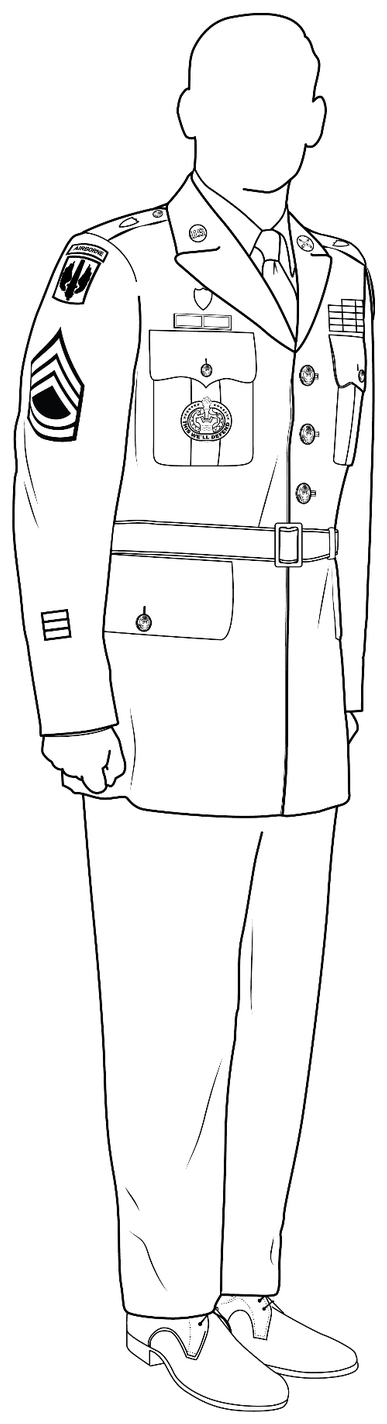
Grooming is half the standard. The other half is whether the uniform itself is assembled correctly — and this is where NCOs quietly lose credibility, because the details are easy to get wrong and easy for everyone else to see.

  • A nameplate 1/4 inch off is visible from across a formation.
  • Ribbons out of precedence say you didn't check.
  • A beret worn with the AGSU says you don't know the rule.
Why an NCO owns this

Your Soldiers will wear it the way you wear it. Not the way the regulation says — the way the NCO standing in front of them does it.

If you're wrong, you just published the error to everyone who works for you.

The heritage colors have names, and using them correctly is its own small signal of professionalism: heritage green, taupe 565, tan 566, walnut 567.
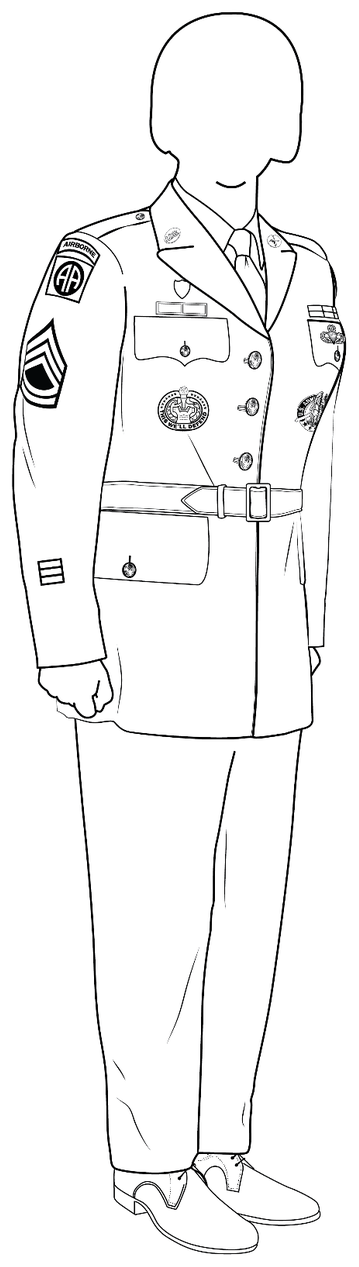
NCODP · Leader Presence & Military Bearing
Block 4 — The Standard in WritingAD 2025-18, encl 2

AGSU — where everything goes

Male and female placement differ, and the reason is structural
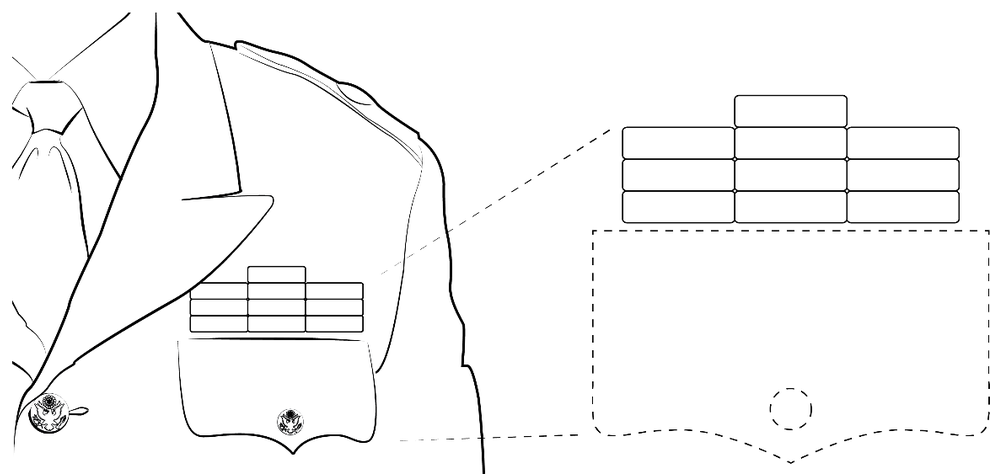
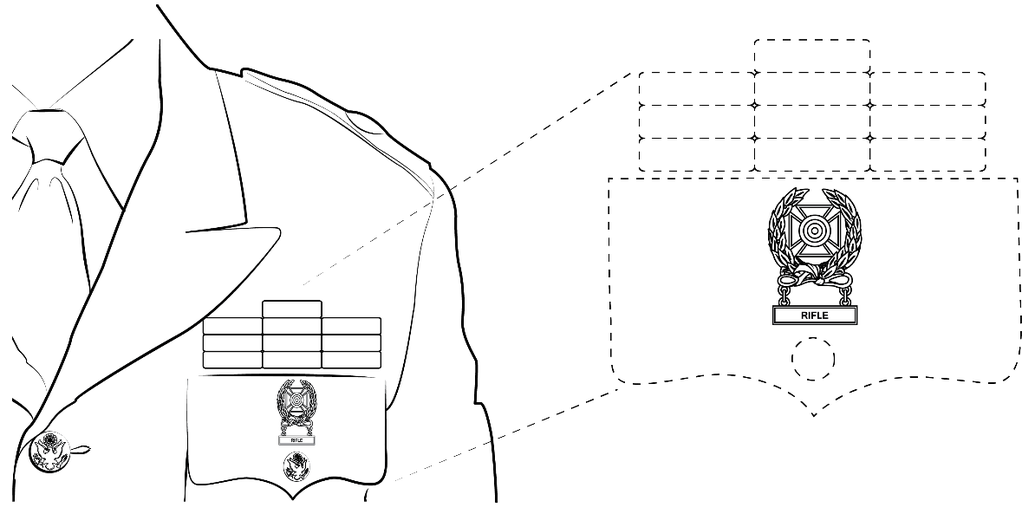
MALE — AGSU COAT / SHIRT FEMALE — AGSU CLASS B 1 2 3 4 1 2 3 4 1 Nameplate 2 RDI 3 Ribbons — max 2 rows, 6 total 4 Badge — one only Wearer’s right is the viewer’s left. Dashed line = ribbons flush with the RDI.
Placement differs because the female Class B shirt has no breast pockets. Nameplate — male: centered on the flap of the wearer’s right breast pocket, between the top of the button and the top of the pocket; female: 1 to 2 inches above the top button, centered horizontally on the wearer’s right. RDI — male: 1/4 inch above the wearer’s right pocket flap; female: 2 inches below the right collar tip and 2 inches to the right of the necktie, or roughly 3 inches from the second button when no necktie is worn. Ribbons (no more than two rows, six ribbons total, in order of precedence) — male: 1/4 inch above the wearer’s left pocket flap; female: 2 inches below the left collar tip, centered on the body, bottom flush with the bottom of the RDI. Badge — one combat or special skill badge or metal tab replica, 1/4 inch centered above the ribbons. Identification badges are not authorized on the AGSU Class B or tropical dress variation.
NCODP · Leader Presence & Military Bearing
Block 4 — The Standard in WritingDA PAM 670-1

What right looks like

The official plates — reproduced from DA PAM 670-1, 26 January 2021
Line drawing of the Army green service uniform worn by an enlisted male Soldier
Enlisted, maleDA PAM 670-1, Fig 14-3
Line drawing of the Army green service uniform worn by an enlisted female Soldier
Enlisted, femaleDA PAM 670-1, Fig 14-4
Detail drawing showing ribbon placement above the left breast pocket of the AGSU coat
Ribbons on the AGSUDA PAM 670-1, Fig 22-4
Detail drawing showing a single badge worn centered above the ribbons on the AGSU
One badge on the AGSUDA PAM 670-1, Fig 22-26

DA PAM 670-1 is the illustrated companion to AR 670-1 — when you need to know exactly where something goes, this is the book with the picture. Note its date: 26 January 2021. Where AD 2025-18 changed a standard — hair, nails, cosmetics, earrings — the directive controls and these plates do not reflect it.

NCODP · Leader Presence & Military Bearing
Block 4 — The Standard in WritingAD 2025-18, encl 2

The AGSU rules people get wrong

ItemStandard
Black beretWill not be worn with any variation of the AGSU.
NameplateRequired on the AGSU coat, short- and long-sleeved shirts, Ike jacket, and heritage 564 pullover. Not on the leather jacket or the windbreaker. Last names only. 1 in × 3 in, dark brown with taupe lettering.
Neck tabRequired with the long-sleeved shirt worn without the coat, and with either shirt worn with the Class A coat. Optional with the short-sleeved Class B.
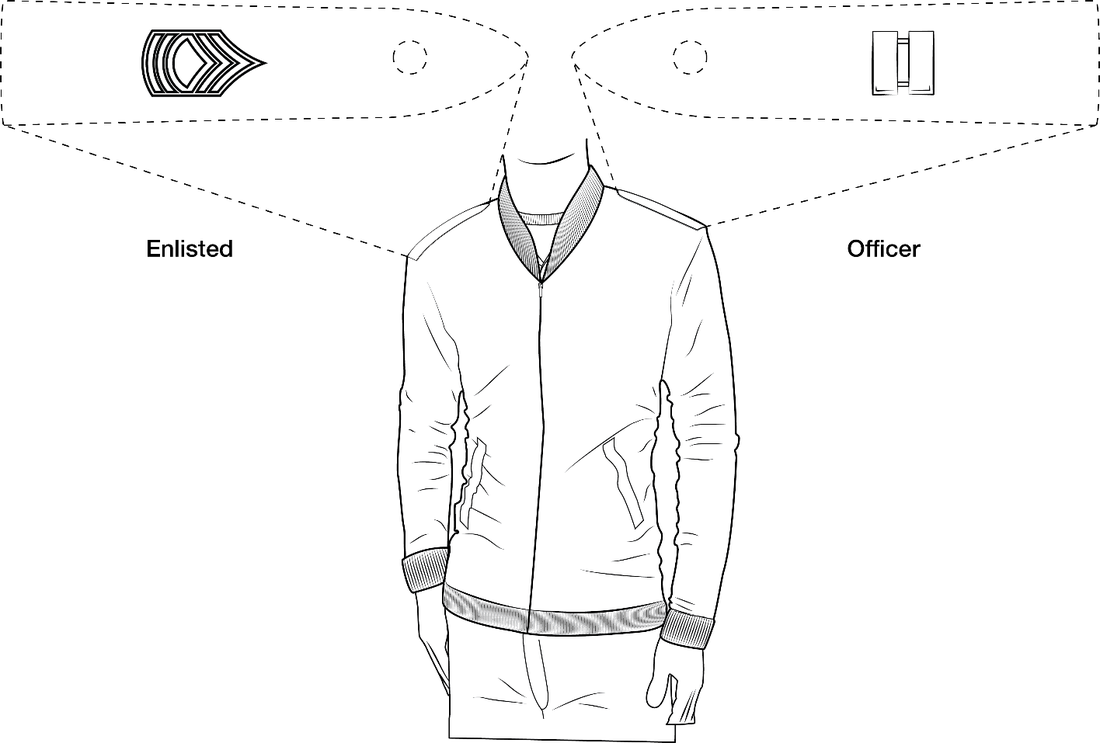
WindbreakerWorn zipped to at least the second button down. Officers: nonsubdued pin-on grade on the shoulder loops. NCOs: shoulder marks. Other enlisted: nonsubdued grade on the collars. Not worn in formation unless the commander authorizes it.
BadgesOnly one combat or special skill badge or metal tab replica. Driver and mechanic badges are not authorized above the ribbons. Only Group 3 and 4 badges may be worn below the ribbons.
ID badgesNot authorized on the AGSU tropical dress variation or Class B.
OxfordsPolished regularly. Worn with the ASU and garrison culinary uniforms.
Line drawing of the heritage green windbreaker showing shoulder loop insignia
Windbreaker, heritage greenDA PAM 670-1, Fig 20-15
NCODP · Leader Presence & Military Bearing
Block 4 — The Standard in WritingAD 2025-18, encl 2

OCP and the PT uniform

ACU / IHWU — shoulder sleeve insignia

  • The full-color SSI and SSI-MOHC may be worn only when authorized by the commander.
  • When authorized, worn centered on the hook-and-loop pad on the sleeve — centered both horizontally and vertically on the sleeve pocket.
  • Full-sized, full-color embroidered special skill tabs — Special Forces, Ranger, Sapper, President's Hundred — may be worn with the full-color SSI.

APFU — the runner's belt

  • Black only, and no wider than 4 inches.
  • Commanders may authorize leaders to wear one — only while in the APFU. Not with OCP or service uniforms.
  • Leaders may place a cellphone in the belt, not visible.

Soldiers are not authorized to wear wireless or non-wireless headphones or earpieces while conducting physical training outdoors. This one catches people constantly.

NCODP · Leader Presence & Military Bearing
Block 4 — The Standard in WritingAD 2025-18, encl 3

Appearance has a career consequence

The Army Body Composition Program changed in 2025 — and the Guard rule is different
Commanders will direct a body fat assessment on any Soldier who they determine does not present a Soldierly appearance to ensure the Soldier meets the screening table weight for the Soldier's measured height. AD 2025-18, Encl 3 — amending AR 600-9, para 3-2d
Army National Guard & Reserve

If a Soldier continues to exceed body fat standards after 6 months in the ABCP, the commander will involuntarily transfer the Soldier to the IRR.

Regular Army & AGR

Same 6-month clock, different outcome: in the absence of a diagnosed underlying medical condition, the commander initiates separation action.

On enrollment, the commander requests a medical examination to rule out an underlying condition.

Flag Code K (ABCP noncompliance) is no longer transferable. A Soldier cannot move the problem by moving units.

NCODP · Leader Presence & Military Bearing
Block 4 — The Standard in WritingTechnique

The head-to-toe sweep

Check yourself in this order before you check anyone else
THE SWEEP same order, every Soldier, every time 1 Headgear & hair 2 Face — clean-shaven, cosmetics 3 Collar & nameplate 4 Insignia, ribbons, badges 5 Hands — nails, rings, tattoos 6 Belt & buckle alignment 7 Trousers & blousing 8 Boots — serviceable, laced Roughly fifteen seconds per Soldier once the order is habit.
Run the sweep in the same order every time. A fixed sequence is what stops you from fixating on the first thing you notice and missing everything below it — and it makes the inspection feel procedural rather than personal, which is exactly the point of the on-the-spot correction. Check yourself in the same order before you check anyone else.
NCODP · Leader Presence & Military Bearing
Block 4 — The Standard in Writing0:36

The on-the-spot correction

The most-used and worst-executed NCO skill there is
STEP 1Private when you can. Public when you must.Safety and standards that affect the formation get corrected now.
STEP 2Name the standard, not the person."The reg says 1/4 inch" — not "you look like a mess."
STEP 3State the correction and the timeline."Fixed before first formation Sunday."
STEP 4Check back.An uncorrected correction teaches that standards are optional.
STEP 5One at a time.Stacking five corrections is a counseling, not a correction.

Sounds like

  • "Hey Sergeant — sidewalls. Before formation."
  • Four seconds. Done. No audience.

Doesn't sound like

  • Sarcasm, or a lesson for the benefit of onlookers
  • "I shouldn't have to tell you this"
  • Correcting a Soldier in front of their own subordinates
NCODP · Leader Presence & Military Bearing
Block 4 — The Standard in Writing0:38

Scenario

Discussion 3 · 3 minutes

It's Saturday morning formation. A Staff Sergeant from another platoon — senior to you, not in your chain — is clearly out of standard. Two of your Soldiers are standing next to you and have obviously noticed.

  • Do you say something?
  • If yes — when, and how?
  • What do your two Soldiers learn from whichever choice you make?

Anchor the discussion in the directive: "any Soldier can address a situation that warrants an on-the-spot correction." The authority question is settled in writing. What's left is the how — and that's a bearing problem, not an authority problem.

NCODP · Leader Presence & Military Bearing
Block 5 — The NCO as Standard-BearerTC 7-22.7

The Noncommissioned Officer Guide

TC 7-22.7 — current edition August 2025

TC 7-22.7 is the Army's guide for NCOs on leading, supervising, and caring for Soldiers. It's the publication that describes what the Corps expects of you specifically — not of leaders generally.

The current edition opens on the professional NCO, the Army Profession, our Ethic, and the Army as a military profession — professional identity before technique.

The structural point

Officers own what and why. NCOs own how and to standard.

"To standard" is not a supporting role. It is the entire mechanism by which an order becomes a trained, repeatable capability — and it runs on your presence.

Get a current copy. The August 2025 edition supersedes the 2015 version many of us learned from. If your leader book has the old one, replace it.

NCODP · Leader Presence & Military Bearing
Block 5 — The NCO as Standard-BearerThe NCO Creed

The Creed is a presence document

Read it again as an NCO, not as a private memorizing it
No one is more professional than I. … I am proud of the Corps of Noncommissioned Officers and will at all times conduct myself so as to bring credit upon the Corps, the Military Service and my country regardless of the situation in which I find myself. The Noncommissioned Officer Creed
"At all times"

Not in formation. Not at drill. At all times. The Creed set the 24/7 standard long before anybody had a social media account.

"Regardless of the situation"

This is the resilience and bearing clause. It anticipates precisely the bad days from slide 18 and declines to offer an exemption for them.

NCODP · Leader Presence & Military Bearing
Block 5 — The NCO as Standard-BearerADP 6-22

Counterproductive leadership

Doctrine names this. It is not a personality clash.
…the demonstration of leader behaviors that violate one or more of the Army's core leader competencies or Army Values, preventing a climate conducive to mission accomplishment. ADP 6-22 — counterproductive leadership

What it looks like in a section

  • Public humiliation used as a correction tool
  • Taking credit; distributing blame downward
  • Different standards for favorites
  • Withholding information to stay necessary
  • Performing for seniors, dismissive with subordinates

What it costs

  • Soldiers stop reporting problems early
  • Initiative disappears — nobody risks being wrong
  • Your best people transfer or don't reenlist
  • The climate degrades faster than it recovers

Note the definition ends on climate. This isn't about being unpleasant. It's about producing an environment in which the mission can't be accomplished.

NCODP · Leader Presence & Military Bearing
Block 5 — The NCO as Standard-Bearer0:43

Presence doesn't come off with the uniform

Especially in the Guard, where your Soldiers live in your town

Online

Your Soldiers follow you. What you post, what you react to, and what you argue about at midnight is all bearing — observed, screenshotted, and permanent.

In town

Guard NCOs run into their Soldiers at the grocery store, the gym, the bar. There is no garrison gate between your professional life and your private one.

About the unit

How you talk about your chain of command in front of Soldiers is a bearing decision. You can disagree up. Complaining down is corrosive.

The test: would this post, this conversation, or this Saturday night make it harder for one of my Soldiers to take an order from me on Sunday morning? If yes, it's a presence problem — whether or not it's a UCMJ problem.

NCODP · Leader Presence & Military Bearing
Block 5 — The NCO as Standard-BearerFM 6-22 (Nov 2022)

Now develop it — in yourself and in them

FM 6-22, Developing Leaders — the "how" manual behind ADP 6-22

FM 6-22 covers the methods that span formal leader development: assessing, counseling, coaching, mentoring, broadening, and team building.

The loop that actually works

Assess → Feedback → Practice → Reassess.

Presence is trainable. It is not a personality you were issued. But it does not improve without an outside observer, because you cannot see your own bearing.

Three things you can do this drill

  1. Ask for it. "What do I look like when I'm stressed?" Ask a peer who'll tell you the truth.
  2. Counsel on it. Presence is a legitimate developmental counseling topic — DA Form 4856. Most NCOs never counsel anyone on it.
  3. Name it when you see it. "The way you handled that formation — that's what bearing looks like." Positive correction is still correction.
NCODP · Leader Presence & Military Bearing
Close0:45

Knowledge check

Rapid-fire — answers visible to facilitator only
  1. Name the three attributes in the Leadership Requirements Model.Character, Presence, Intellect
  2. Name the three competencies.Leads, Develops, Achieves
  3. What are the four components of Presence?Military and professional bearing, fitness, confidence, resilience
  4. Define military and professional bearing.Projecting a commanding presence, a professional image of authority
  5. Which publication is the NCO Guide, and what's the current edition?TC 7-22.7 — August 2025
  6. Max bulk of male hair at the top of the scalp? At the sides?2 inches top; 1 inch sides
  7. In which uniforms may a female Soldier wear a ponytail?ACU and APFU only — not any dress variation
  8. Which paragraph of AR 670-1 governs tattoos?Paragraph 3-3
  9. Define counterproductive leadership.Leader behaviors violating core competencies or Army Values, preventing a climate conducive to mission accomplishment
  10. Which form is used for developmental counseling?DA Form 4856
NCODP · Leader Presence & Military Bearing
Close0:48

Three things before next drill

Write them in the back of your pocket book now — not later
ONEA bearing fix you own.From Discussion 2 — where yours breaks first.
TWOOne Soldier you'll counsel on presence.DA Form 4856. Name them now.
THREEOne standard you'll stop walking past.You already know which one it is.

The third one is the hardest and the most important. Every NCO has a standard they've quietly decided isn't worth the friction. Your Soldiers know exactly which one it is — they learned it from watching you walk past it.

NCODP · Leader Presence & Military Bearing
Close0:50

References & AAR

Everything in this block came from

ADP 6-22Army Leadership and the Profession (2019)
FM 6-22Developing Leaders (Nov 2022)
AR 670-1Wear and Appearance (26 Jan 2021), as amended
AD 2025-18Appearance, Grooming, ABCP
AD 2025-13Facial Hair Grooming Standards
AD 2022-09Soldier Tattoos
TC 7-22.7The NCO Guide (Aug 2025)
Now the AAR

Forms are coming around. Four questions:

  1. What was supposed to happen?
  2. What actually happened?
  3. What went well — and why?
  4. What do we improve — and how?

Be honest. If this block was too long, say so. The next NCODP is built from these.

No one is more professional than I.

NCODP · Leader Presence & Military Bearing